

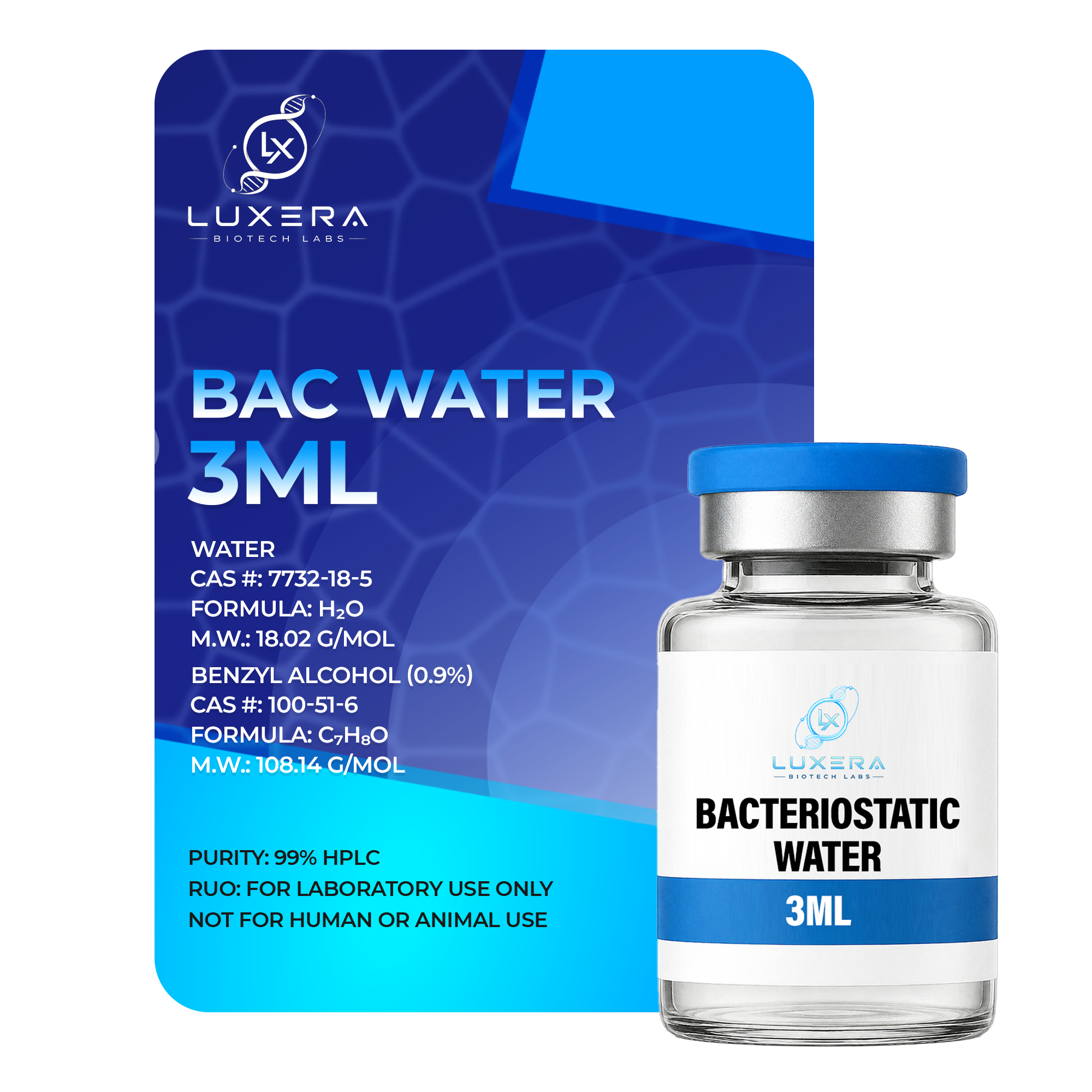
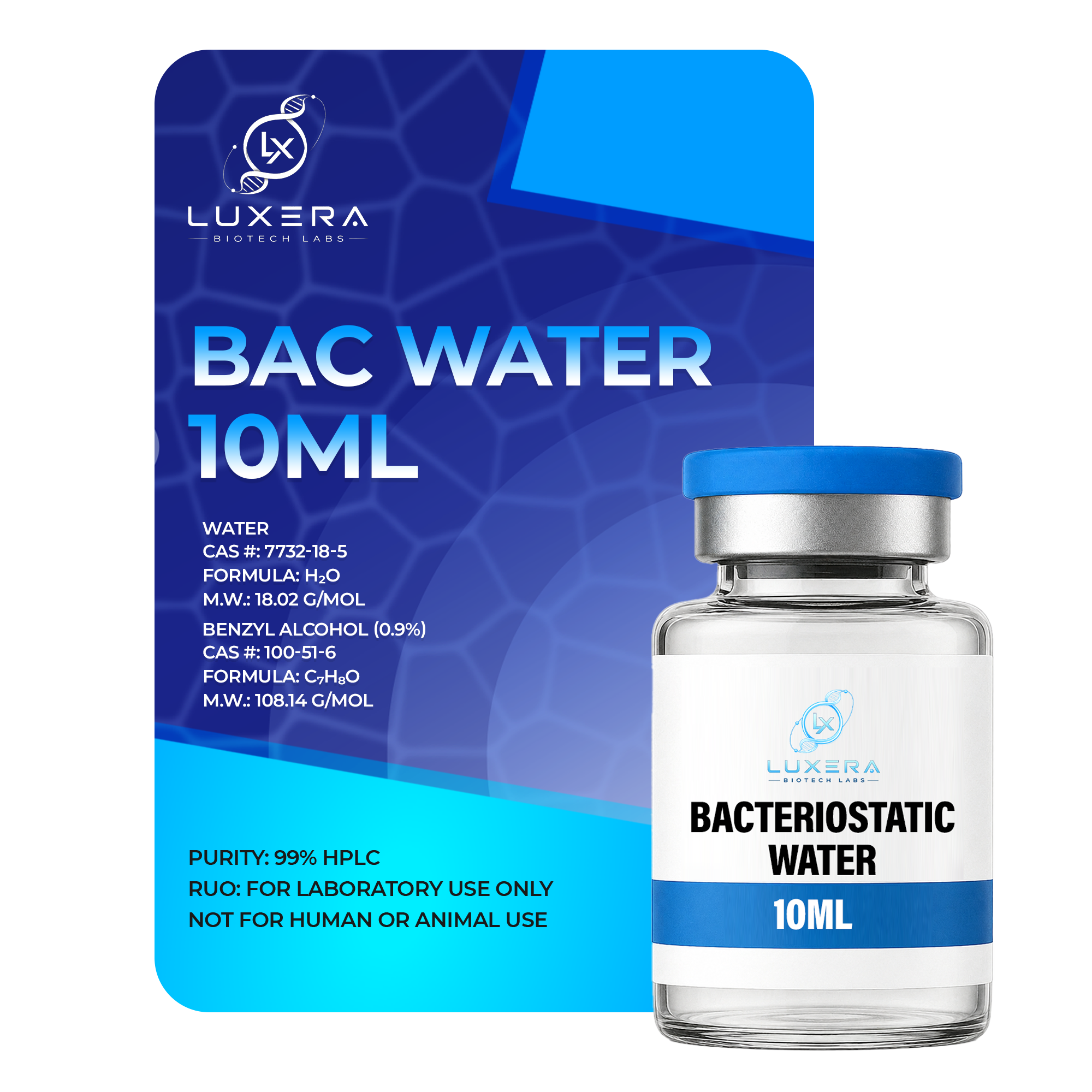
Bacteriostatic Water
Price range: $13.00 through $18.00
Bacteriostatic Water for Injection is a USP-grade sterile, non-pyrogenic aqueous solution containing 0.9% benzyl alcohol as a bacteriostatic preservative. Widely used in research laboratories as a multi-dose reconstitution solvent for lyophilized peptides and investigational compounds requiring extended in-use stability.
What Is Bacteriostatic Water?
Bacteriostatic Water for Injection is a pharmaceutical-grade sterile aqueous diluent formulated with 0.9% (9 mg/mL) benzyl alcohol as a bacteriostatic preservative. The water component meets Water for Injection (WFI) standards — purified via distillation or reverse osmosis, pyrogen-tested, and produced under controlled manufacturing conditions. It is structurally distinct from standard sterile water in that its preservative content enables repeated multi-dose access without compromising solution integrity.
Mechanism of Preservation
Benzyl alcohol exerts its bacteriostatic effect through membrane disruption — integrating into bacterial lipid bilayers, increasing membrane fluidity, and destabilizing surface structures. This inhibits bacterial cell proliferation without necessarily eliminating organisms (bacteriostatic, not bactericidal). Published research using Raman spectroscopy has characterized this membrane interaction at a molecular level (PMID: 26519389). The 0.9% concentration is the USP-established standard sufficient for preservation while maintaining broad compatibility with peptide sequences.
Research Applications
In controlled laboratory environments, Bacteriostatic Water is utilized for:
- Peptide reconstitution — dissolving lyophilized research compounds including BPC-157, TB-500, and GHRPs prior to experimental use
- Multi-dose solution preparation — enabling repeated withdrawals from a single vial over an extended research period
- Controlled dilution protocols — preparing working concentrations of investigational compounds under aseptic conditions
- Stability studies — serving as a reference diluent in peptide degradation and compatibility research
Purity & Quality
Manufactured under cGMP-equivalent conditions. Pyrogen-free status confirmed via LAL or recombinant Factor C (rFC) assay. Lot-specific Certificate of Analysis (CoA) provided with each batch.
Composition: Water for Injection + 0.9% Benzyl Alcohol | pH Range: 4.5–7.0 | In-Use Period: Up to 28 days post-puncture (aseptic technique required) | Storage: Room temperature, sealed; 2–8°C post-puncture
| Dose | 3ml, 10ml |
|---|
Related products
-
All
HCG
$69.00 Select options This product has multiple variants. The options may be chosen on the product page -
All
CJC-1295 with DAC
$89.00 Select options This product has multiple variants. The options may be chosen on the product page -
All
5 Amino 1MQ
$89.00 Select options This product has multiple variants. The options may be chosen on the product page -
All
MOTS-C
$59.00 Select options This product has multiple variants. The options may be chosen on the product page
Reviews
There are no reviews yet.